
by Elaine Leahy, Marblehead Conservancy Board of Trustees
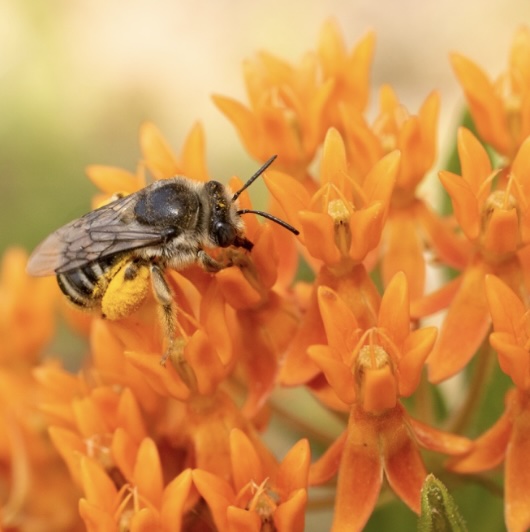
Do bumblebees have a “voice” that only a mother could love? No, it turns out certain plants like tomato and blueberry also love the bee’s buzz—sometimes compared to a middle-C note—that is produced by the rapid movement of the bee’s wings. “The bees are literally singing to the flowers!” said Nick Dorian, Ph.D., at the Marblehead Conservancy’s annual membership meeting on April 29. This process, called buzz pollination, shakes loose pollen that would otherwise stay trapped, essentially rewarding the bees for hitting just the right note. The scientist regaled the crowd gathered at the Abbot Public Library with this and many other animated and entertaining tales of bees, while also sharing the results of his yearlong research into the habitat restoration and visiting pollinators that he and colleague Max McCarthy conducted at the Lead Mills Conservation Area in 2025.
Bees might look like their more aggressive cousins, yellow-jacket wasps, but their role couldn’t be more different. Instead of hunting other insects, bees rely on pollen and nectar. In the process, they help pollinate about 75% of the world’s leading crops and nearly 90% of wild plants. Most bees don’t live in hives and aren’t aggressive. In fact, the majority are solitary and nest in the ground. The small sand mounds you might assume belong to ants could actually be the entrance to a bee’s home. “Sandy ant hills contain holes that are the size of spaghetti,” explained Dorian. “Whereas the cellophane bees are in holes the size of a bee or a little larger.”
Results of the Lead Mills Study
What is now known as the Lead Mills Conservation Area once housed a white lead manufacturing plant that produced almost 6,000 tons of lead annually. That’s the weight of about 6,000 Beetles (of the old Volkswagen variety) each year. After decades of neglect, the 4.5-acre site became conservation area thanks to many dedicated community members, and is now under the stewardship of the Marblehead Conservancy.
For the last decade, the Conservancy has been working strategically to convert the land into a native wildflower meadow to increase biodiversity and native pollinators. They continually remove invasive plants and have added thousands of square feet of wildflowers and shrubs that are crucial to the survival of pollinators such as bees and butterflies.
In 2025, they contracted with Dorian to conduct a yearlong impact assessment of the pollinator habitat restoration. He documented an impressive 120 species of pollinators, including 70 species of bees. An additional 17 species of butterflies and moths were observed. Goldenrod was the most-visited plant, followed by boneset, daisy fleabane, and common milkweed. Among shrubs, pollinators favored northern bush-honeysuckle, white meadowsweet, and purple flowering raspberry.
The full report is available here.
Use S.E.E.D.S. to Save Native Bees
To describe several easy steps to help save our native bees, Dorian uses the acronym S.E.E.D.S. Let’s look at them one by one.
“S” is for “Spread native plants.” If you don’t have much space, potted plants are a great choice. If you have room, try adding a few natives, consider converting a portion of your lawn into a native garden, or take the plunge of making a whole bed into a native pollinator paradise. The key is variety: choose flowers with different shapes, colors, and sizes, and aim for blooms throughout the growing season so bees always have a food source. Some favorite flowers include goldenrod, milkweed, wood aster, yellow wild indigo and Joe-Pye weed. For shrubs, try cherries, black chokeberry, winter berry, high and bush blueberry. Finally, grasses are great for food and shelter for species like skipper butterflies. Dorian also emphasized that a garden should reflect you and not to feel guilty about planting annuals that you love. Remember that even if you add one native plant for the bees, you’re already doing more than most.
“E” equals “Employ a life cycle approach” for yard maintenance. Dorian recommends delaying spring clean-up to allow the bees more time to mature, advises to mow half as often, to look before you prune, and not to disturb the ground where bees are nesting.
The next “E” stands for “Eliminate pesticides.” The same chemicals that kill mosquitos also kill bees, not to mention the risks they pose to human health and pets, and how they can wash through storm drains into our harbor and ocean.
“D” is for “Discover what’s around.” Dorian quoted a line from a Mary Oliver poem: “Attention is the beginning of devotion.” He added, “Attention is also the beginning of conservation.” The more we notice, learn about, and appreciate our natural surroundings, the stronger our desire to protect them becomes. We all should slow down, pay attention and take in the beauty found in nature.
The final “S” stands for “Share with others.” Dorian reminded us that “it takes a hive” so share what you learn and what you are doing in your garden with others. We all have a chance to “cultivate hope along with flowers” when we act together.